

Certificate of Completion:
Once you have completed the program, you will have the opportunity to download and/or print a certificate of completion. This certificate will acknowledge that you have watched or attended all pre-recorded and live webinar classes throughout the program and that you have completed the associated quizzes.
This program also includes group consultation. If you are unable to attend any of the consultation groups live and online during the program, you will be given the option of submitting questions ahead of time that the group can discuss during the consultation session. All sessions will be recorded.
Program Requirements for Certificate of Completion:
- Watch all pre-recorded classes
- Attend or watch all live webinars (attendance is strongly recommended, however, all live webinars will be recorded)
- Complete all associated quizzes
Registering for CSU Credit:
Registration Cost: $65 for EACH credit hour paid to CSU
You must register with CSU BY 12/15/26, to receive credit for this program, and once you register you cannot drop the course nor receive a refund from CSU.
Program Requirements for CSU Credit:
- Register with CSU and pay associated fee
- Watch all pre-recorded classes
- Attend or watch all live webinars (attendance is strongly recommended, however, all live webinars will be recorded)
- Complete all associated quizzes
- Complete additional coursework as outlined below
Recommended Textbooks:
Chose whichever focus fits your professional orientation.
Education Focused:
- Desautels, Lori (2020) Connections Over Compliance: Rewiring Our Perceptions of Discipline.
Mental Health Focused:
- Dion, Lisa (2018). Aggression in Play Therapy: A Neurobiological Approach for Integrating Intensity.
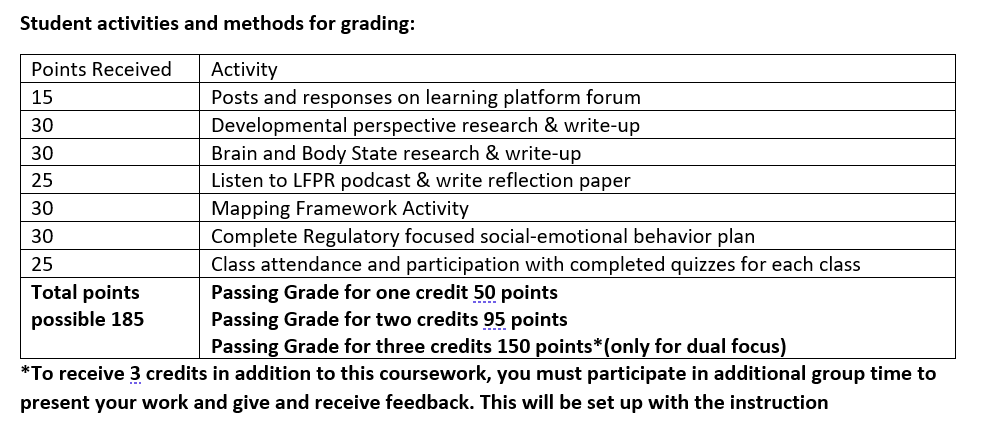
Assignments:
- Section 1 post on forum
- Brain and Body State research & write up
- Developmental perspective research & write up – DUAL FOCUS COHORT ONLY
- Mapping Framework Activity
- Listen to the 20-minute podcast called “How Trying to be Calm Gets in the Way of Regulation” and write a one page reflection paper
- Section 2 post on forum
- Section 3 post of forum
- Complete a regulatory-focused social-emotional behavior plan
The course is Pass/Fail.
Please read the General registration document and the cohort specific document below to register for CSU credit by 12/15/26 deadline:
General Registration Information for All
Registration for Student-Focused Cohort
Registration for Dual-Focused Cohort
______________________________________________________________________________
Specific Assignments and Materials
To turn in assignments, please upload to your goggle drive folder. The link is provided by your instructor.
SECTION 1:
Assignments
- Post: As you have looked at your own, and others’ behaviors through a brain state and stress response lens, what have you noticed? How has using this lens impacted your thinking and/or behaviors? Post Due 10/12/26
- Brain and Body State research & write up Assignment Due 10/26/26
- Developmental perspective research & write up Assignment Due 11/9/26
Materials
- Research and Write-Up Assignment Instructions
- Developmental Perspective Template
- Brain and Body State Template
SECTION 2:
Assignments
- Listen to the 20-minute podcast called “How Trying to be Calm Gets in the Way of Regulation” and write a one page reflection paper. Assignment Due 11/16/26
- Posts: As you think about using the concepts of Braindrops, Learning Tools and somatosensory regulation, what challenges and benefits do you perceive Understanding that co-regulation starts with us, also has challenges and benefits. What do you see as the biggest challenges, and what are your thoughts for addressing them? Post Due 11/23/26
Materials
- Lessons From the Playroom Podcast Reflection Paper Instructions
- Lessons From the Playroom Podcast #118: How Trying to be Calm Gets in the Way of Regulation
SECTION 3:
Assignments
- Analyze an interaction using the mapping framework to better understand what might have caused escalation and alternative ways to approach the dynamic. Assignment Due 12/14/26
- Post: Understanding that relationship dynamics are complicated and based on past associations and patterns can help us recognize that how a student is behaving is “not about us.” How does seeing behavior and dynamics through this lens impact your own thinking and behavior? Post Due 12/21/26
- Complete a regulatory focused social-emotional behavior plan. Instructions and forms are below. Please have a specific student in mind and create a plan that you will be able to implement. Layered Social-Emotional Behavior Plans will be discussed in our final two classes. Assignment Due 1/18/27
Materials