
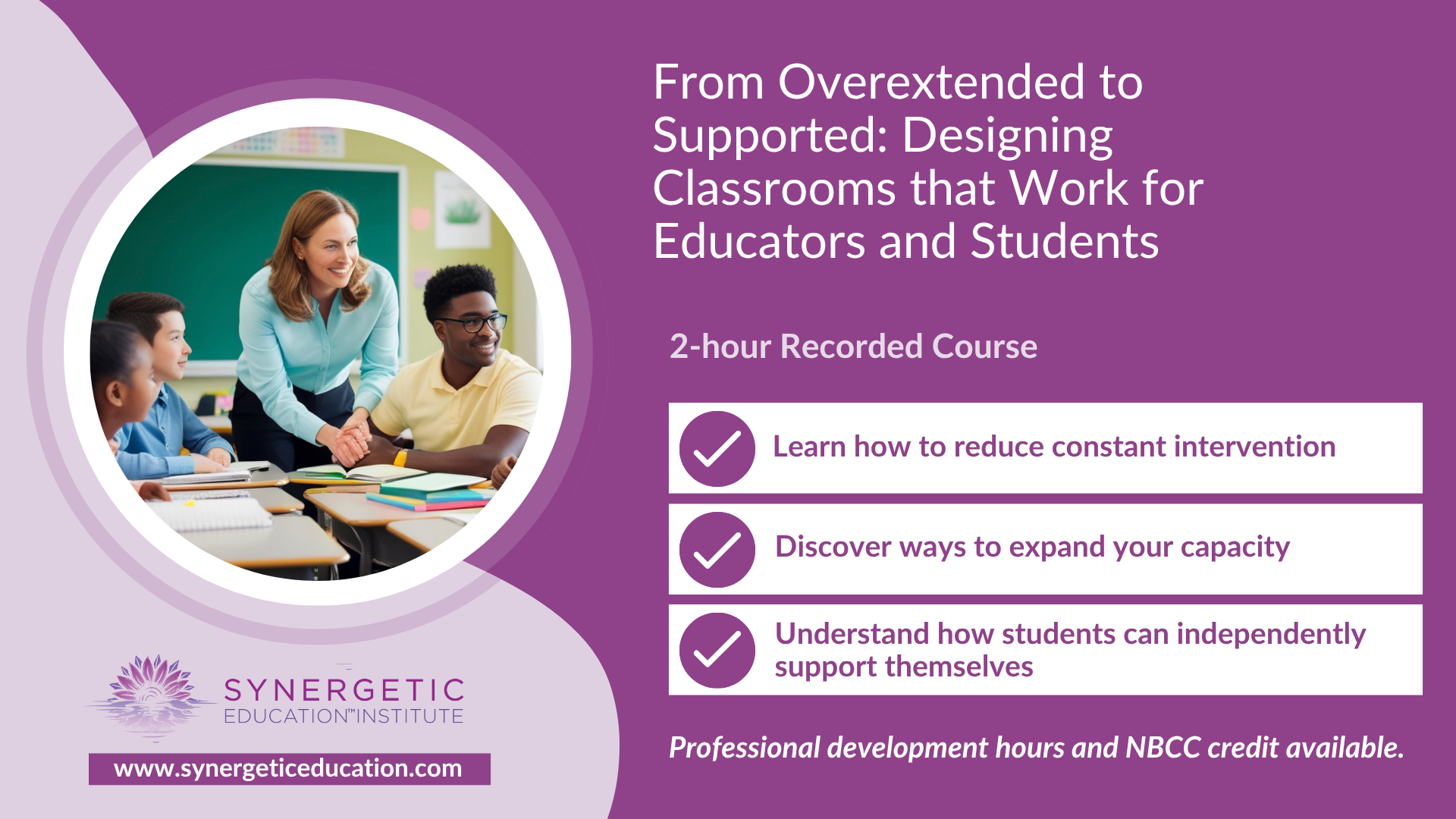
Join us for this two-hour recorded course as we explore creating environments that do more of the work!
Why This Matters Across Roles
For teachers – without enough outside support available, you’re left addressing most behavioral needs within the classroom, often without programs or strategies that work consistently. Constant individual intervention is not sustainable.
For student support providers – with large caseloads, you can’t individually meet every student need. You need more effective universal support available in the classroom so you can preserve more of your capacity for students who need targeted services.
For leaders – with fewer support staff, you’re increasingly called on to address challenges in the classroom, taking time away from other responsibilities. You can’t sustainably be available every time a need arises, and teachers can’t be expected to fill the gap by overextending. Universal classroom support can reduce reliance on both.
For those supporting schools – Without a shared language that bridges education and mental health, it can be challenging to align your work with the realities of school settings. Bringing these perspectives together creates a stronger foundation for collaboration with educators and schools.
So, what’s the answer? Building support into classrooms in ways that allow more students to independently access what they need throughout the day.
Grounded in brain science, this webinar explores practical ways to design classroom conditions that support students and adults without depending on continual educator overextension.
What You’ll Learn
Explore practical ways to create classroom environments that support:
☑️ Less reliance on constant educator intervention
☑️Fewer disruptions to teaching and learning
☑️Greater student independence
Who Should Attend?
This webinar is designed for all educators and others who impact students, including classroom teachers, behavior and SEL coaches, school counselors, psychologists, social workers, paraprofessionals, and educational leaders.
It is also for mental health professionals working in or with schools. Whether you work directly in schools or in private practice, you’ll leave with insights and tools you can use immediately to explore with educators how classroom environments shape what is possible for students and adults.
Join Us
Register for this course and discover what becomes possible when the environment provides more of the support educators and students need.