

The Synergetic Education Institute Approach
Who We Are
SEI exists to support learning environments where educators and students are met as they are, supported through challenge, and able to stay grounded and authentic within the realities of demanding work. We operate at the intersection of education and mental health, recognizing that learning, regulation, and well‑being are inseparable in school communities.
We partner with educators and schools through professional learning, coaching, and systems support, translating neuroscience into practical, developmentally responsive approaches. These approaches can be applied in real‑world school contexts and sustained through everyday demands and each educator’s unique role. In practice, we help educators understand what brains and bodies need in challenging moments. Small shifts can create conditions that make regulation and learning more accessible. These shifts expand what’s possible for students and adults across the day while reducing reliance on ongoing individual intervention.
Through applied science and role‑aligned professional learning, SEI helps educators stay with what’s happening, use what fits, and make choices informed by neuroscience, even when the work is messy.
If you want to learn more about who we are explore our Philosophy and Tenets page by clicking below.
What Makes Us Different?
It’s an all too common experience to hear, “I don’t remember the last time I ended a day feeling satisfied instead of just relieved it was over.” Instead of defaulting to just getting through the day, SEI focuses on ways to remain engaged, responsive, and internally anchored. This matters most when demands exceed the support available and educators are still required to keep responding. SEI offers an alternative to survival-mode functioning that does not depend on systems changing first. Without this capacity, overextension becomes the only option, and burnout becomes inevitable.
Signature Elements
Three core questions guide this work:
- Why does burnout persist even among motivated, skilled, and deeply committed educators?
- Why do initiatives fail to last even when people buy in?
- Why don’t strategies translate into real change for students?
Our signature elements define how we respond to these questions, guiding practice to meet daily needs across roles and settings.
Our Signature Elements Are:
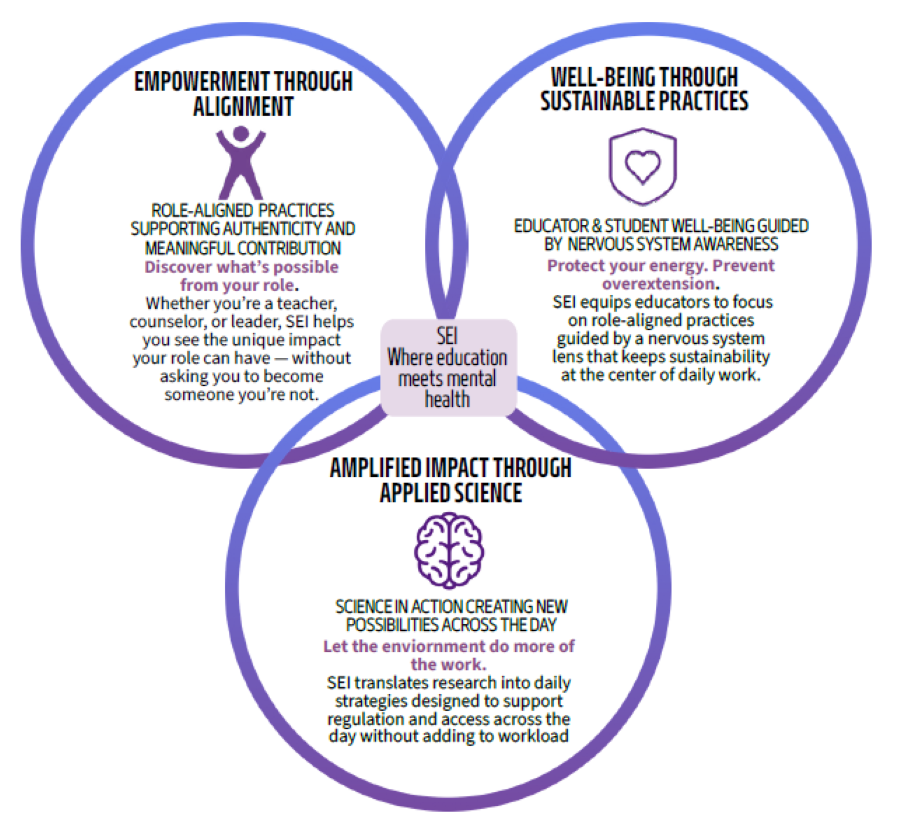
- Alignment – Educators can contribute meaningfully without being asked to become someone they’re not or do work outside their training.
- Sustainability – Practices endure when they honor real nervous system capacity and limits, rather than requiring constant overextension.
- Applied Science – Educator impact is amplified when environments support awareness and exploration of individual experiences and regulatory needs, providing access to supports in ways that sustain learning across the day.
Priorities
These elements take shape through a set of priorities to specifically address burnout, why initiatives don’t last, and how to foster real change.
Our priorities describe how SEI responds to these realities in practice, not by asking educators to do more, but by changing how support, roles, and environments are designed, without relying on overextension or waiting for systems to change.
The Synergetic Education Framework
SEI’s work is organized through the Synergetic Education Framework. It consists of two primary pieces, Core Insights and Responsive Practices. Core Insights describe how we understand the intersection of education and mental health, while Responsive Practices describe how we apply that understanding to support change in schools.

Our Philosophy
The foundational beliefs about how learning, behavior, and collaboration are shaped.
Essential Understandings
Core Concepts – How we make meaning out of what is happening in classrooms and schools. They answer the question “Why is this happening?”
Core Tenets – How learning, regulation, and connection unfold in schools and how to respond within these dynamics. They answer the question “How do I orient to this?”
Signature Elements
The lenses used when applying the framework.
Priorities
Focus areas that make change possible. They answer the question, “What are the conditions that foster change?”
Programs
Structured pathways for learning and applying the framework. They answer the question, “How do I learn what will work?”
Practices
The daily approaches to support students and educators. They answer the question, “How can I apply it in my classroom?”