
The Synergetic Education Framework
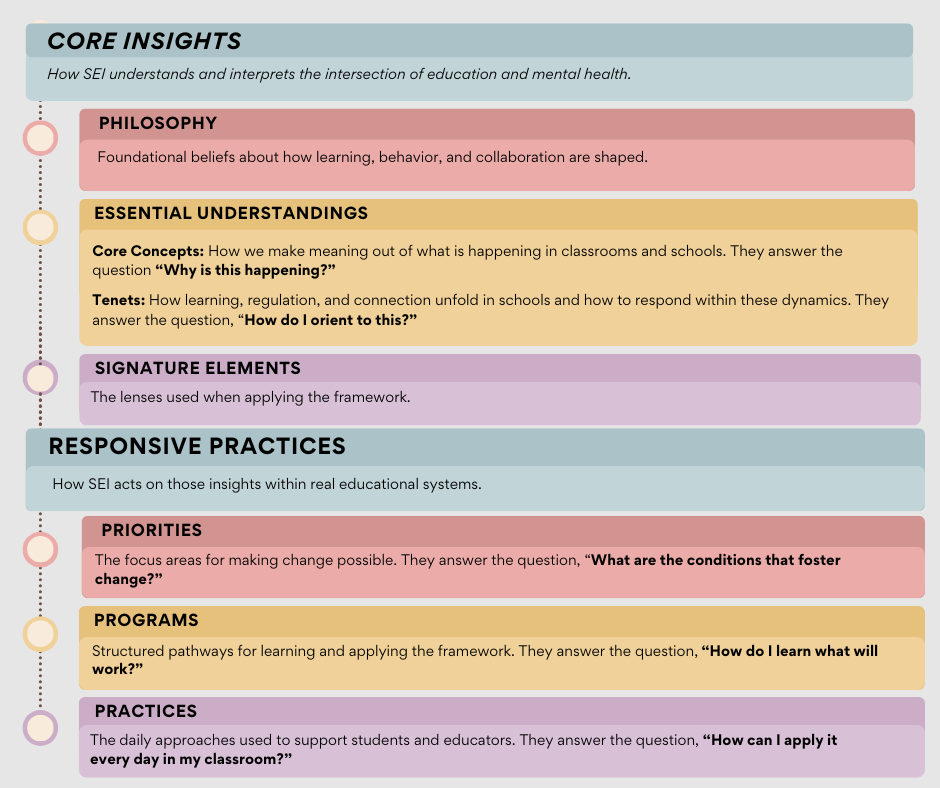
Our framework consists of two interconnected parts, each representing a different layer of the model: Core Insights and Responsive Practices.
Core Insights describe how we understand the intersection of education and mental health.
-
- They clarify how learning, behavior, and collaboration are shaped, answering the question: “What is happening and why?”
- Signature Elements are a key part of Core Insights. They guide how we support educators through three lenses: Alignment, Sustainability, and Applied Science. These lenses are held through the questions:
-
-
- Does this fit the role?
- Is this sustainable?
- How do we apply the science within the system or environment?
-
Responsive Practices describe how we apply that understanding to support change in schools.
-
- They clarify what can be done in real educational environments, answering the question: “How do I use this?”
- Priorities are a key part of Responsive Practices, guiding how we design support and environments for sustainable change. These are grounded in three core questions:
-
-
- Why does burnout exist even among motivated, skilled, and deeply committed educators?
- Why do initiatives fail to last even when people buy in?
- Why don’t strategies translate into real change for students?
-
The framework moves from understanding to application. Each layer builds on the one before it, helping educators shift from insight into practice within real-world school environments.
To learn more about specific elements of the framework click on the links below.
Philosophy establishes the foundational beliefs
Explore philosophy
Essential Understandings clarify how to interpret what is happening
Signature Elements guide how the work is applied
Priorities define the conditions needed for change
Programs support learning and integration
Practices bring the work into daily environments